Interview with Doom and Bloom

Dr. Bones and Nurse Amy
A few weeks ago I was interviewed by Nurse Amy of Doom and Bloom on their Blog Talk Radio Channel. We discussed a variety of topics that I think you guys will enjoy. I talked about a few items that you may not find here on the website or on our YouTube videos. Things like firearm ownership, self defense, urban survival, escape & evasion, and much more. 

Here are the link to check them out:


The Tiered System and How It Can Help You Develop Your Kits


I want to introduce a tiered approach that I take that may simplify things. This may help you in development of your kit(s). First you will need to know what event's your planning for. This will determine much of what you pack and how many of the tier's I'm going to describe.

Tier 0-Knowledge: Your most important tier. This may involve paying for training which is why I include it in the tiered system. You may find yourself in a situation where all of your gear has been lost or taken and you have to improvise and your life depends on your resourcefulness. Knowing how to start fires, build shelter, procure food, and make weapons should be part of  your skill sets.

Tier 1-EDC/SERE Kit: This includes your pocket knife, multi-tool, wallet, key ring, flashlight, cell phone, and so on. Your cutting tool (pocket knife) being the most important since its the hardest to replicate in the wild and it can accomplish many survival task. It doesn't matter if its a swiss army knife or a $300 tactical folder. It will most likely be your only knife with you when things go sour- since its difficult to get away with a fixed blade in your day to day life. Your Pocket Survival Kit or SERE kit as I like to call it. Typically if you have this and only this; you have had to leave your main pack behind. More than likely your surviving, evading, resisting, and escaping (SERE). These items will be small tools that will aid you and your knowledge (tier 0) should do the rest.

Tier 2-72 Hour Kit/EDC Bag/Get Home Bag: This kit encompasses those items that you have in a small bag. It could be in your vehicle, your EDC Bag, or 72 hour kit. These are larger and more comprehensive tools than whats found in your EDC or SERE Kit. You want to focus on sheltering devices like space blankets, small sleeping bags, mylar bivvy sacks, and heat sources for maintaining core body temps (like fire starting equipment). You will also want to have food stuffs like jerky/MRE main meals/granola bars. Items that don't require cooking. Have some water, a way to carry it, and a way to find or get more potable water on the move. Boiling is not the best option when your trying to get somewhere. So I would say to carry small purifying straws or water purification tablets. Small trauma kits would also go into this category. A small fixed blade knife and multi-tool could also serve you well. This kit is best designed to sustain you for a few days to get you to your desired location. You don't want to have to stop and build shelters, cook food or boil water. Your mission objective is to get to a safe place in the shortest amount of time. We will have a article published soon on "Defining the 72 hour kit" and this will go over the criteria for kits of this application.

Tier 3-72 Hour Kit and Beyond/BOB: In my opinion your BOB is not a 72 hour kit. A BOB is gear that you may need to survive in an unknown situation. Mainly because your having to "bug out" from your safe house and move away from danger. Could you use your BOB for a 72 hour kit? Sure, however I like to separate mine because my BOB is to extensive to carry everyday and have within an arms reach. This kit would also include larger firearms like rifles and more ammo, food acquiring equipment, cooking equipment like stoves, larger scale comm systems (HAM radios), major sheltering systems (down sleeping bags, tents, hammocks, and tarps), comprehensive medical kits, an environmental gear such as a change of clothing, larger buschcrafting tools like saws, pack-able axes, and larger knives. Again, this system is for the unknown, when you've had to leave your house, bug out location, or safe house and you may be placed in a survival situation  Field craft skills are also a must for this scenario.

The water gets muddied on kit applications. Many people run systems together and this will leave you in a bad position. It's better to have yourself set up for success by developing systems around these types of scenarios. Also not that these kit items can be modular. Meaning that you don't need a flashlight for every tier. You will already have it on you and it can be used for that next tier. We will try and do a video on this subject in the future- if you guys are interested.


Springtail Solutions MPAC Review

I'm sure if your a frequent visitor of our site that your a person that likes to be prepared. Generally we all carry some sort of equipment in our vehicles EDC gear, Get Home Bag, Bug Out Bag, etc...

If your like me and own a jeep you know storage is at a minimum. While surfing the web I came across the MPAC from Springtail Solutions. This is a uniquely designed system that marries a few different useful features.
There are dynamic straps attached to the velcro panel to ensure the pouches
stay on in rough terrain
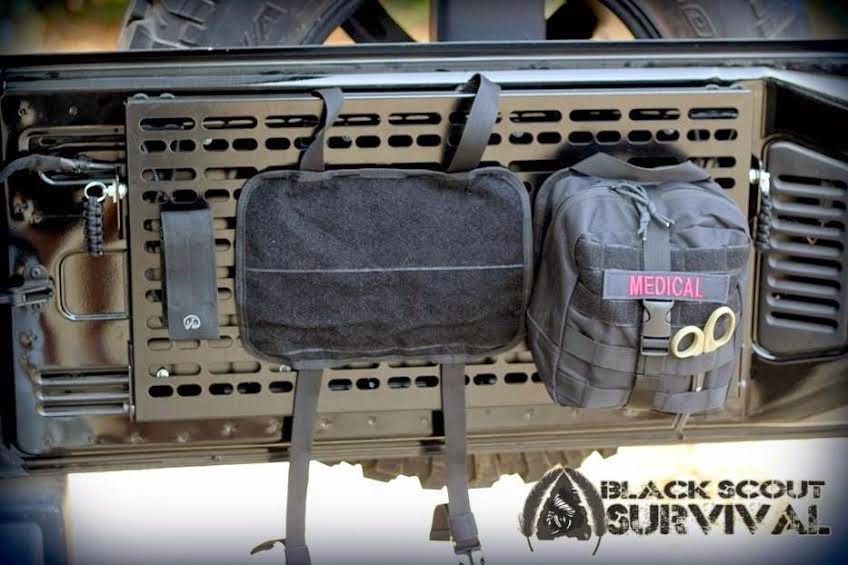
The system mounts to the Jeep JK rear door. Its a heavy duty piece of laser cut steel that requires no drilling for installation by using stock body mounts. The MPAC has rack has a solid quality powder coat that has a grid pattern cut out of it to accommodate MOLLE webbing. The package I purchased included 2 pouches (1 large and 1 small). These pouches have rip-away velcro that is great for accessing and or using your gear when away from the vehicle.
The STAT pouches are constructed from water resistant 600 denier nylon. The larger pouch has one main large central pocket with two interior pockets and a mesh on the opposite side. It also includes a shoulder strap in the event you have to leave the vehicle and need to carry your gear on foot. The smaller pouch has just one central interior with no internal pockets. I've set mine up to have survival gear in the larger pouch and the smaller contains various medical supplies.

Probably the most awesome feature is that the MPAC folds down into a table. It is suspended by 550 cord and can be adjusted. I've already used the table numerous times and truly don't know how I lived without it.
By pulling the paracord lanyard on each side the folding table can be deployed. The design is rattle free and is designed to hold up to 40 lbs.
Leatherman attached to the MPAC grid
Your not limited to the STAT pouches; the MPAC allows you to attach any items that have MOLLE webbing. They also offer different accessories that can hold tow straps, flashlights, axes, etc...

I love the organization the MPAC offers. The folding table has been helpful almost on a daily basis. I highly recommend the MPAC if you have an FJ Cruiser or Jeep JK.

Check them out at: http://store.springtailsolutions.com/JK-Rear-Door-Folding-TrayMOLLE-Panel-Combo_p_29.html

Training: your most important piece of survival "gear"

Many of us get caught up in gear. Spending tons of money on the latest and greatest equipment. Don't get me wrong, I do love gear just as much as the next guy. The problem is that I don't see that many that spend any money or effort in their training. You will always have your training but you can't say the same about your gear.

When I say training, I don't specifically mean going to attend training (although I highly recommend it). I believe experience is just as important as training. I know when I've faced a situation that I have faced  before I generally know how to handle it. Why? Because I've already dealt with it before.

A saying that we use in the military is that "you will always default to your level of your training". Many people think that when they face a situation they will "rise to the occasion". As many have found out- that's not the case. You will always resort back to your level of training.

Lets look at it from a fitness standpoint. Do you believe that if you've been living an unhealthy lifestyle; that you would be able to bug out on foot on a ten mile ruck to get to your bug out location? I'm sure there are many out there that believe that they will. I know better. Don't let your fantasies get the best of you. If you have never pushed yourself to that physical capacity; then more than likely you will not when it becomes reality.

There are endless survival resources online. You could spend hours online looking at the plethora of "survival experts" on YouTube. If moneys tight and that is the only option you have; its better than nothing. I would encourage you to get out and practice those skills and gain that "experience" like I stated above. By failing to do certain things you may learn how to do them right. An example of this is friction fire. You may fail a hundred times before you get it. But the experience will help you. This may even lead you to shortcuts or better methods of doing things. You can also receive free training from the American Red Cross.

If you can afford to spend some money, I would suggest getting training in the areas below:

Some of these skills you can gain from friends; others you may have to go find a professional to teach you. Bottom line is to get out and do it. Save that money that you spend on the latest and greatest gadget and go learn some skills that you will always have with you.


SERE TIP #33

Prior to going on operations behind enemy lines or whenever you may need to go undetected (escape or evasion/bug out situation) - its wise to reduce your scent signature. In your day to day life you may often notice foreign smells very quickly. Its something that your not used too. Start a few days prior by eating what the locals eat and bathe how and with what the locals do. Think of it as camouflage for the nose.

L.T. Wright Genesis Review

In the survival community you have to admit that the primary piece of gear is knives. Most all of us have way more than we need. We try to justify it to our wives/girlfriends but they don't understand. Don't worry I do and keep buying them- you need them! You don't but I thought I would make you feel better.

Over my course of knives my preference has changed like most of you. As of now I typically carry a "one-tool" option full tang fixed blade made of some super steel and pretty thick blade. Now most of the time when backpacking, camping, hunting, fishing, etc... this is overkill. Most camp chores need little more than a four inch blade. When bushcrafting we tend to carry knives, axes, and saws. With this combination your trading the weight from a "one-tool" option to a few tools. Typically because this is when your life is not in danger and you practicing your skills. Or if you choose to operate like those frontiersman a few years back (okay maybe for than a few years).

In my survival load out I tend to carry a few knives. One being a 4 inch and that tends to pull the brunt of the work as I've said before. I've wanted to try a dedicated bushcraft knife to really see how well it performed. For this challenge I chose the L.T. Wright Genesis. The Genesis is about as bushcraft as you can get when it comes to knives.

Here are the Specs:
Overall Length: 9"
Sharpened Edge: 4.25"
Steel: 1/8" A2
Grind: High Polished Scandi
Handle: Green Micarta


Out of the box the knife is a piece of art. Its truly a beautiful piece that looks like an heirloom piece that will be passed down generations. The Scandi grind is extremely sharp and holds an edge very well. Literally the hairs jumped off my arm as I skimmed it with the blade. This scandi grind has a super high polish with a 0 degree edge. This makes for extremely smooth cuts.

I was somewhat skeptical about the strength of a 1/8" knife but my skepticism quickly faded after the tons of batoning I delivered with the knife. The A2 steel was a good choice for this knife and solid design proves that the Genesis is a formidable woods blade.

The handle is a "broomstick" style (basically that its rounded with a straight shape) built from aesthetically pleasing green blasted micarta. Again seeing the knife may lead you to believe its going to be uncomfortable; it was anything but. This has to be one of the most comfortable knives I've owned. It has a full grip even though its paired with a thin blade. You have plenty of real estate to get a solid hook up when using the Genesis. There are also "thumb scallops" on the handle that I've not seen before. They allow the user to hold the knife comfortably in a variety of methods. There is also a brass lined lanyard hole at the rear of the knife.

The back edge of the knife has a 90 degree spine built ready to shave flaming shards off of a ferrocerium rod. This is also beneficial when scratching off a fine tinder pile from a piece of fat wood.

Securing the Genesis comes by way of a very gorgeous leather bushcraft pouch. This sheath can be suspended by a dangler system or ride high with conventional loop. There is also a firesteel loop that will hold up to a 3/8" ferro rod.

Overall I really like the feel, looks, and performance of the Genesis. If your in the market for a dedicated bushcraft knife I recommend going over and checking them out by clicking HERE.

All Matches Aren't Created Equal

Left to Right: UCO Stormproof Match, British Lifeboat Match, Hurricane Match,
Coghlans Wind/Waterpoof Match, Strike Anywhere Match (waterproof treated),
Coghlans Waterproof Match, MRE Damp Proof Match
Matches are not my go-to fire starter. I'd prefer a Bic Lighter or a Ferrocerium Rod to them every day of the week and twice on Sundays. Even still I do carry matches as one of my 3 ways to start fire. Why? Because they are easy- if you carry the right kind.

Sometimes you need an ignition based flame for lighting oil lamps or candles. Matches with a long burn time and that can withstand high winds, at times are superior to lighters.

I've used a variety of matches over the years and it has came down to to styles that I tend to keep in my kit. Those are Strike Anywhere Matches and the UCO Stormproof Match. Strike Anywhere style matches are good when you may have lost your striking pad. Outside of that they tend to fair poorly against many others. My preference goes to the UCO Stormproof Match and we will be discussing them today.
The UCO Stormproof Match kit seen above comes with a water/crushproof case, 3 striking pads, and 25 matches. These matches will burn underwater or even with smothered with sand. They have a 15 second burn time and will burn in the strongest of winds. We have a video on our YouTube channel showcasing some of these capabilities.

The matchstick is somewhat larger than many others on the market. I like that it allows me to keep my hand a little farther away from what I am lighting. You can trim them to put them into your survival kit or standard match cases if need to.
As you can see, the UCO case is much larger than a standard waterproof match case. It will take up a bit more room (although I think it's deserving room). It has a spot on the exterior of the case to hold a striking pad. A nice feature that keeps you from fumbling with a striker strip or leaving your matches exposed while trying to light them. Theres also room in the case to add a few cotton balls. I do this to keep them from rattling and to use as emergency tinder.

The case is super strong. I've seen a few videos where this case is ran over by a truck with no failures. I like survival orange, but it can also be had in safety yellow and military OD Green.

If your looking for matches I highly suggest you grab some of these.